Brent's Method on CUDA
One independent root-finder per GPU thread. The first CUDA implementation of Brent's method.
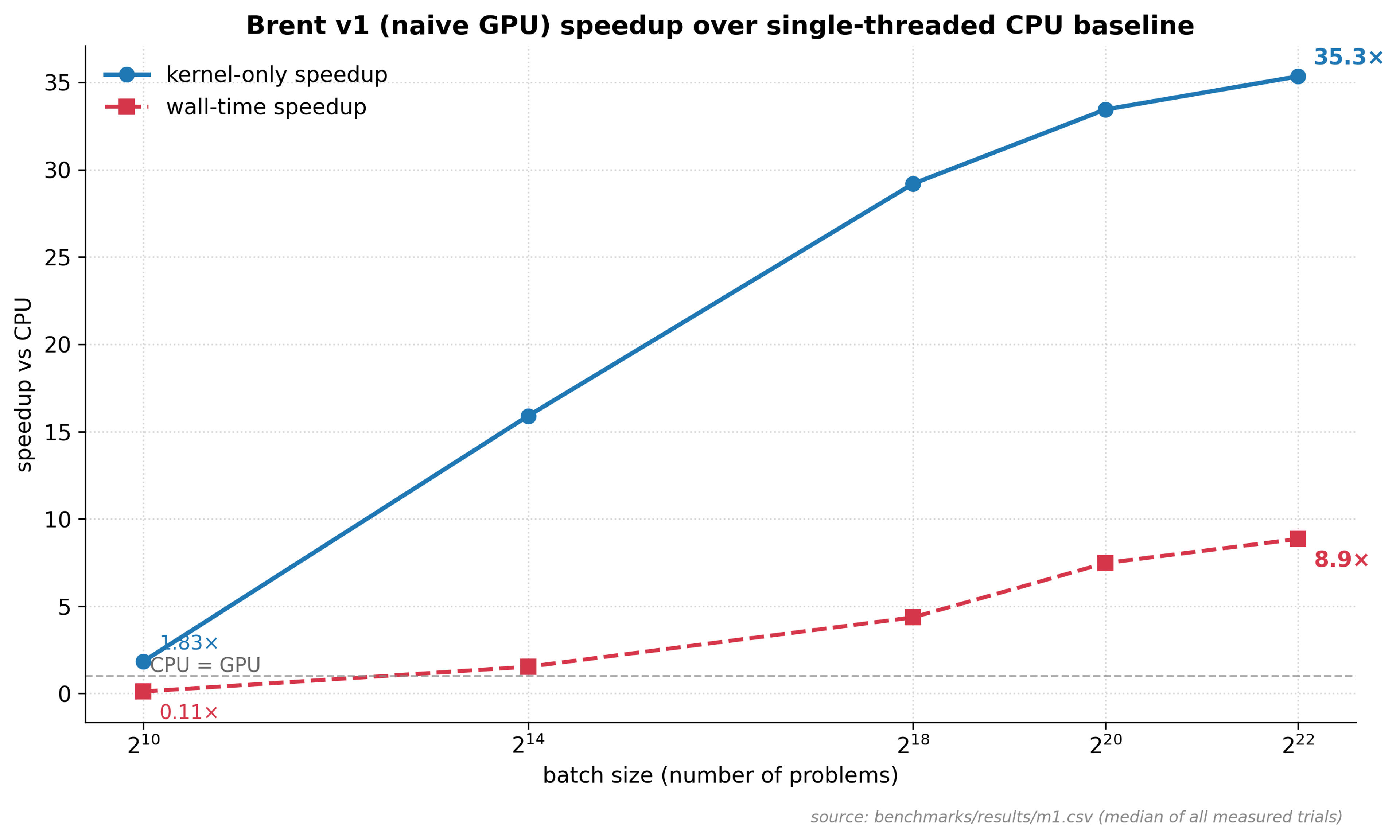
- 35.31×kernel speedup vs single-thread CPU
- 8.79×end-to-end on an RTX 3080
- <1e-10fp64 deviation across Python, C++, CUDA
Root-finding refuses to parallelize.
Brent's method is the workhorse of numerical root-finding: robust, derivative-free, and stubbornly sequential. Each iteration depends on the one before it, so a single solve cannot be spread across GPU threads.
But scientific workloads rarely need one root. They need thousands of them: the same equation swept across parameters, ensembles, and batched simulations. That reframing is the whole trick.
Batch parallelism, one solver per thread.
Instead of parallelizing inside the algorithm, each CUDA thread runs a complete, independent Brent's solve. The project built the same solver three times, in reference Python, single-thread C++, and CUDA, and validated every implementation against a Python ground truth.
The hard part was bit-level discipline: keeping fp64 results identical across all three implementations, so the GPU version is a drop-in replacement rather than an approximation.
35 times faster, provably identical.
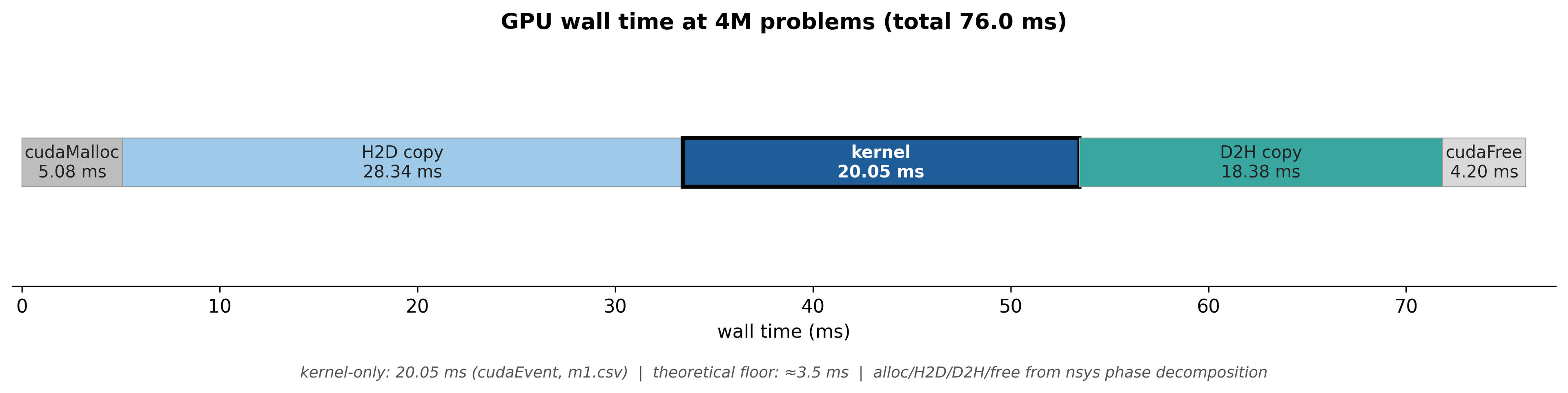
On an NVIDIA RTX 3080 the CUDA kernel solves batches 35.31 times faster than the CPU baseline, and 8.79 times faster end-to-end including transfers, with results validated to below 1e-10 against the reference. The same technique generalizes to any batchable numerical method.
- CUDA
- C++
- Python
- CMake
- GPU Computing
- Numerical Computing